Introduction:
A high-level policy engagement and dialogue was convened with the major objective of collaboratively strengthening public accountability and corporate compliance for methane emissions in Nigeria’s oil and gas sector. Co-hosted by the Nigeria Extractive Industries Transparency Initiative (NEITI), the Natural Resource Governance Institute (NRGI), and the Paradigm Leadership Support Initiative (PLSI), the event brought together key stakeholders, including representatives from the National Assembly, government regulatory agencies, civil society organisations, community members, media, and oil and gas companies.
Opening Remarks and Agenda Setting:
The opening session featured remarks from Dr. Orji Ogbonnaya Orji (NEITI), Tengi George-Ikoli (NRGI), Olusegun Elemo (PLSI), and Hon. Ahmed Aluko (House Committee on Gas Resources). Dr. Orji emphasized that “business as usual” on methane emissions must end, referencing NEITI’s integration of methane and GHG data into its audits and a new climate accountability framework mandating action on flaring, divestments, and host communities. He called for the complete elimination of gas flaring and warned that Net Zero ambitions are unachievable without addressing methane. Ms. George-Ikoli stressed the importance of aligning Nigeria’s gas-centered transition with robust methane governance to remain globally competitive, highlighting the need for collaboration, transparency, and accountability from industry and regulators. Mr. Elemo outlined PLSI’s strategy to support policy implementation through tools, dashboards, and the newly launched Policy Accountability Lab, and emphasized synergy across stakeholders. Hon. Aluko pledged the legislature’s support for a strengthened methane emissions framework, confirming the committee’s readiness to drive necessary reforms and oversight.
Core Presentation: Strengthening Nigeria’s Methane Emissions Framework
The core presentation, delivered by Tengi George-Ikoli (NRGI) outlined the urgent need to strengthen Nigeria’s methane emissions framework. Methane was described as a potent but often overlooked greenhouse gas, with venting identified as the primary emissions source in the oil and gas sector. While regulatory progress and voluntary corporate disclosures exist, enforcement remains weak and reporting fragmented. Key gaps include limited legal requirements for methane reporting, ambiguous flaring permit criteria, inadequate penalties, and poor interagency coordination. The presentation warned that Nigeria’s market access, particularly to the EU, is at risk without stronger compliance. Proposed solutions include legislating reporting standards like OGMP 2.0, amending the Climate Change Act, criminalising non-compliance, enhancing penalties, establishing a multi-agency steering committee, and building institutional capacity. A phased reform roadmap was recommended, with emphasis on data transparency, technological innovation, and stakeholder engagement.
Panel Discussion:
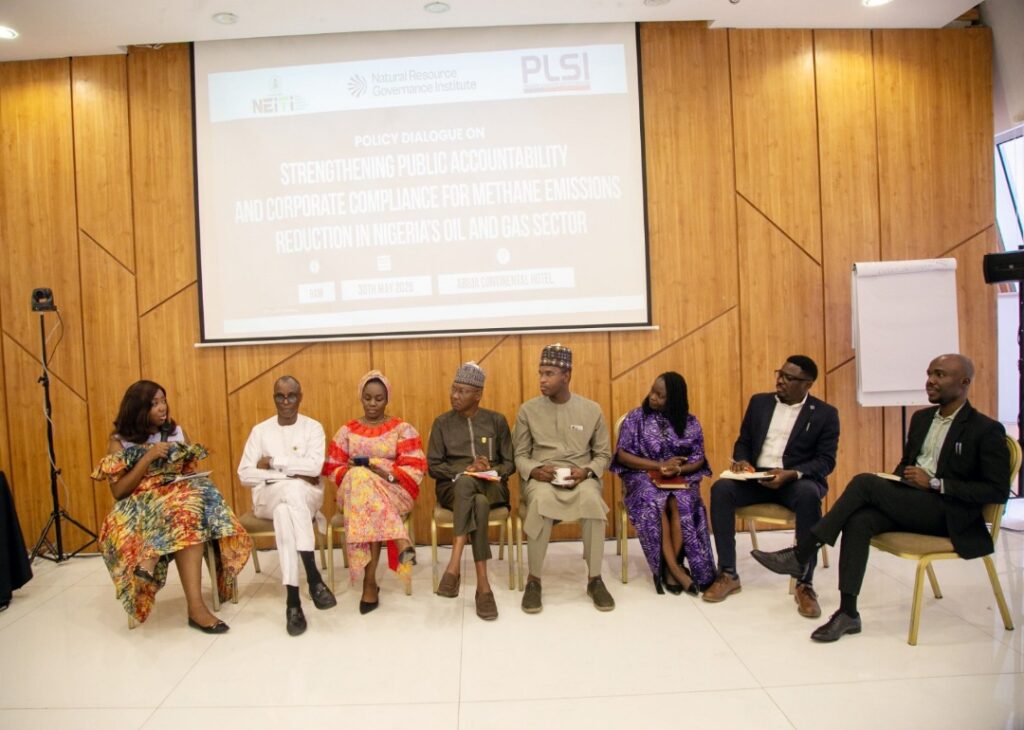
The panel session provided a platform for key stakeholders to share perspectives on data, transparency, accountability, and the regulatory framework for achieving methane reduction targets. Moderated by Tengi Georgikoli , the panel included representatives from NUPRC, NMDPRA, NEITI, CATF, CGID, NNPC Ltd, and PLSI .
Key points raised by panelists:
- Mr. Ibrahim (representing NUPRC): Stated that from the regulator’s view, the existing rules, legislation, regulatory framework, and specific guidelines on GHG emissions are adequate . He expressed concern about a knowledge gap between regulators and civil society and stressed the need for consistent communication . He disagreed that the current frameworks are inadequate, highlighting Nigeria’s clear targets and legal framework . Regarding the EU regulations and OGMP 2.0, he stated that NUPRC’s framework is public and ready for independent assessment, always aiming for the best global standard . He confirmed NUPRC is a responsive organisation that adjusts as new standards become known . He later added that the PIA and an upcoming regulation will mandate NUPRC to produce an annual industry report on a state and license basis, which will provide the required data and information .
- Miss Selena (representing NMDPRA): Identified capacity as a challenge, noting it’s an evolving space . Regarding legislating OGMP, she argued against forcing the adoption of one legislation, advocating for ease of business and working towards best practices . She contended that some information presented about gaps was inaccurate, stating that penalties for not reporting gas flaring are clearly stated in the midstream gas regulations . She clarified that safety/operational reasons for flaring are spelled out and understood in the industry, even if not by non-technical individuals . She noted that methane is more of a resource than waste in the midstream sector (used for power, CNG, LNG), with emissions being mostly fugitive and addressed by leak detection . She felt there is too much attention on methane in this space, arguing against reinventing the wheel with new committees and advocating for utilising existing structures like the Climate Act . Collaboration and responsibility are key, with every individual needing to do their part . She noted minimal compliance in company reporting frequency based on regulatory requirements .
- Dr. Dieter Basi (representing NEITI): His primary concern is encouraging more companies beyond the initial 15 to report their methane and GHG emissions for comprehensive data . NEITI is working to align its reporting cycle with NDCs and ETP and track emissions, including from venting and flaring . He mentioned a study on the economic implications of energy transition, including stranded assets and socio-economic impacts . He suggested viewing methane and other gases as assets rather than waste to address energy poverty . NEITI aims to report realistically on NDC target implementation, noting the ambitious nature of the targets . Public access to NEITI reports is crucial for community awareness and holding companies accountable . Data helps assess the trajectory towards NDC targets .
- Dr. Mohammed Aminu (representing CATF): Believes Nigeria is well-prepared technically, commercially, and regulatory, citing existing methane regulations (first in Africa) and the proactive approach of entities like NLNG regarding competitiveness and future technologies like Carbon Capture and Storage (CCS) . He sees no major challenges besides the emergence of new producers creating more competition, where Nigeria has a first-mover advantage . Collaboration is very important as climate change affects everyone, and the effectiveness of work depends on government cooperation .
- Ms. Felicia Dairo (representing CJID): Highlighted a significant lack of awareness and knowledge about methane emissions at the grassroots level . CGID focuses on building capacity for media to ensure information reaches those most impacted . She stressed the need to simplify technical terms and localise messaging using relatable language and formats (like infographics, social media) so communities understand the impact on their lives and livelihoods (farming, fishing) . Collaboration cannot be overstated and is crucial for achieving the common goal of reducing methane emissions .
- Mr. Vincent Obu (representing NNPC Ltd): Confirmed NNPC joined OGMP in 2024 and is committed to improving measurement and reporting as part of its decarbonisation strategy . They are operationalising commitments, submitting required reports (like Level 1), and receiving support from the OGMP/OGDC ecosystem for capacity building and awareness . Challenges include building internal data capabilities and staying aware of constantly evolving regulations . He thanked the regulators for their collaborative approach, working with companies rather than solely enforcing, and assured they are doing their best .
- Mr. Olusegun Elemo (representing PLSI): Addressed concerns about focusing solely on external regulations by stressing the importance of international market access for Nigeria’s economy . PLSI’s focus is on holding government accountable to its stated commitments, using tools like the Policy Accountability Lab and policy tracker dashboard . He acknowledged the ambition of government targets (like NUPRC’s 60% fugitive reduction by 2031 and 100% flaring reduction by 2030) and stressed the need for data to track progress . While policy may be adequate, there are gaps in transparency around implementation . He called for increased transparency in providing data and seeing “insightful actions” and measurable steps taken towards policy objectives .
Audience contributions during the panel included comments from the Ministry of Finance on the need for their involvement in national-level coordination , a representative from Seplat asking if NEITI accesses regulator data for trend analysis and advocating for realistic, domestically relevant targets , and a representative from the Centre for Environmental Advocacy highlighting the lack of reliable real-time government data and stating that gas flaring is still occurring on the ground, contrary to some reports . A representative from NUPRC further clarified regulatory perspectives, emphasizing that while flaring cannot be eliminated, there are deliberate efforts for regulatory alignment across different laws and that the oil and gas sector is comparatively better than others in data provision for NDC review .
Commitments:
Based on the discussions and presentations, the following commitments were articulated by key stakeholders:
- NEITI: Committed to institutionalising a robust, transparent, and enforceable methane governance regime. Will mainstream methane emissions transparency into national frameworks and continue pioneering methane/GHG disclosures in its reports. Will implement the adopted energy transition and climate accountability framework, mandating tracking and reporting on relevant climate issues including GHG emissions, climate risks, divestments, and Host Community Trusts. NEITI commits to no longer publishing industry reports without climate information . They will also publish annual methane emissions data for covered companies and engage the judiciary on environmental compliance , pressing for full methane disclosures and corporate responsibility . NEITI aligns with the Federal Government’s Net Zero ambition by 2060 .
- NUPRC: Committed to ensuring the adequacy of the legal and regulatory framework for methane emissions and driving towards best global standards. Highlighted the forthcoming regulation under the PIA that will mandate the production of an annual industry report containing comprehensive data on a state and license basis . Stressed the importance of collaboration and responsibility from all stakeholders .
- NNPCL: Committed to operationalising its membership in OGMP 2024 and OGDC, aligning with national goals . This includes submitting required reporting templates imminently and building internal awareness and data capabilities . NNPC is committed to mitigating market risks and staying aware of evolving regulations . They expressed commitment to doing their best and not disappointing the regulators in providing data .
- House Committee on Gas: Committed to working with all stakeholders to establish a coherent and enforceable framework promoting transparency, data integrity, and accountability across the gas value chain. They expressed openness to supporting legislative measures to address identified gaps . The committee is ready to play its role through policy reform, oversight, and collaboration to help Nigeria meet climate obligations while maintaining investor confidence . They committed to remaining a partner in driving a cleaner, safer, and more sustainable gas sector .
Conclusion:
The policy dialogue provided a crucial platform for stakeholders to frankly discuss the complexities of strengthening Nigeria’s methane emissions framework. While significant progress in establishing regulatory frameworks and setting ambitious targets was acknowledged by regulators, concerns persist regarding the transparency of implementation, the availability of granular data, and the need for effective enforcement and accountability mechanisms, particularly felt by civil society and impacted communities. The importance of collaboration among government agencies, regulators, companies, civil society, media, and communities was a shared sentiment, along with the recognition of global market realities necessitating alignment with international reporting standards. Participants looked forward to continued engagement, clearer pathways for reform, and a collective commitment to translating policies and commitments into tangible results for both environmental integrity and socio-economic well-being.