Score: 40%
Rank: 25th
Score: 70%
Rank: 1st
Score: 70%
Rank: 1st
Score: 70%
Rank: 1st
Score: 70%
Rank: 1st
Score: 70%
Rank: 1st
Score: 70%
Rank: 1st
Score: 70%
Rank: 1st
Score: 70%
Rank: 1st
Score: 70%
Rank: 1st
Score: 70%
Rank: 1st
Score: 70%
Rank: 1st
Score: 70%
Rank: 1st
Score: 60%
Rank: 13th
Score: 60%
Rank: 13th
Score: 60%
Rank: 13th
Score: 60%
Rank: 13th
Score: 60%
Rank: 13th
Score: 50%
Rank: 18th
Score: 50%
Rank: 18th
Score: 50%
Rank: 18th
Score: 50%
Rank: 18th
Score: 50%
Rank: 18th
Score: 50%
Rank: 18th
Score: 50%
Rank: 18th
Score: 40%
Rank: 25th
Score: 40%
Rank: 25th
Score: 40%
Rank: 25th
Score: 40%
Rank: 25th
Score: 40%
Rank: 25th
Score: 40%
Rank: 25th
Score: 40%
Rank: 25th
Score: 40%
Rank: 25th
Score: 40%
Rank: 25th
Score: 40%
Rank: 25th
Score: 20%
Rank: 36th
In 2015, the Federal Government of Nigeria approved the sum of $2.1bn1 to provide intervention package to help bankrupt states in Nigeria pay salaries. While there has been increasing agitation for2 and against3 resource control, not much attention has been given to public finance management practices and accountability mechanisms in state and local levels.
Public audit no doubt plays significant role in improving government’s spending and revenue capacity by limiting fiscal behaviors that result in waste, misallocation or misappropriation and corruption. It is important to recognize the impact of sub-national audit which is aimed at strengthening public finance management and accountability structures at state and local levels as is the practice at the national.
Sub-national audit and other public finance accountability measures are not only crucial for good governance and development but particularly important to fiscal health condition of state and local governments. The inability of public audit to yield intended benefit as provided for in section 125 of the 1999 constitution as amended cannot be separated from the maximum control of the executive arm over the legislature and judiciary at sub-national level. It is therefore important to allow democratic institutions at state and local levels to function effectively so that public resources can be adequately accounted for.
The objective of SAE index 2020 is to assess the level of transparency and accountability operational in the management of public funds in all 36 states of the federation of Nigeria through the lens of public audit and key actors in the public audit cycle. While the methodology and scoring criteria adopted in this assessment has been very objective and dependent on publicly available information, PLSI commits to continuous review of its methodology and scoring criteria.
The SAE index 2020 is an attempt to forge healthy competition to foster accountability in the management of public resources at sub-national level and states now have the opportunity to optimize their financial management practices and improve on their accountability structures.
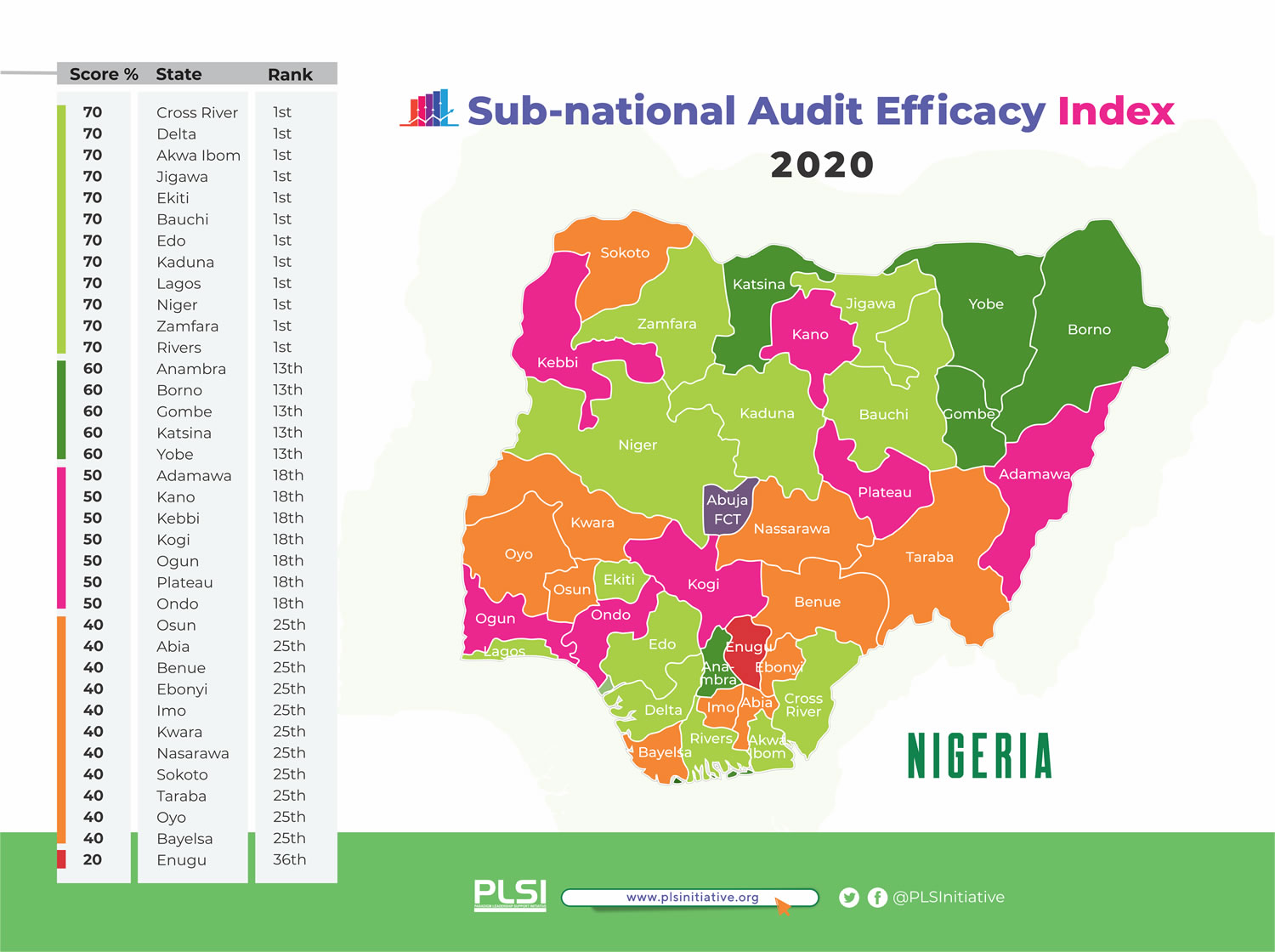
Although there is significant room for improvement, SAE index 2020 ranks twelve states including Delta, Jigawa, Kaduna, Lagos, Niger, and Rivers as states with the most potent audit process in Nigeria having scored 70/100. Also, Anambra, Borno, Yobe, Katsina and Gombe occupied 13th position with 60/100 as their score while the 2020 index ranked Oyo, Sokoto, Imo, Benue among others 25th with 40% score point and Enugu as state with the least potent audit mechanisms having score 20/100 and ranked 36th.
The lack of independence of Legislative arm of government at sub-national level is a cause for concern and this is evident by the recent call for legislative and judicial autonomy4 across the 36 States of the federation. The inability of State Assemblies’ Public Accounts Committees (PACs) to issue recommendations based on their review of Auditor-General’s report is negatively impacting the public audit eco-system particularly at the sub-national level which is in turn hindering accountability in the management of public funds.
Similarly, the failure on the part of sub-national audit institutions to allow for citizens’ participation in the audit process renders audit functions inadequate and unable to facilitate sustainable development. It is disappointing to know that 50% of the states including Sokoto, Imo, Osun, Benue, and Anambra do not have modern audit laws that should guarantee independence of the Auditor-General in their states and enhance effective stakeholder involvement in their states’ audit process. Some states including Zamfara, Delta, Kano and Edo are however showing progress having enacted modern audit laws and should be encouraged to do more. Also, Delta state is among the very few if not the only state that has published audit report on Covid-19 intervention.
1 https://www.bbc.com/news/world-africa-33435399
2 https://www.e-ir.info/2012/05/25/resource-control-in-the-niger-delta-conceptual-issues-and-legal-realities/
3 https://guardian.ng/business-services/governor-condemns-push-for-resource-control-2/
4 https://guardian.ng/news/governors-back-financial-autonomy-for-state-legislature-judiciary/
Sub-national Audit Efficacy (SAE) Index 2020 aggregates data from different sources to assess public finance management practices and accountability mechanisms leveraging on the role of public audit in all 36 states of the federation of Nigeria. The assessment carried out in 2020 focused on data aggregated from 2019 financial year.
PLSI undertakes data integrity exercise to ensure that information used in assessing efficacy of public audit in each state are drawn from reliable sources. Also, certain evaluation criteria are employed in arriving at the SAE index 2020.
1. Select Data Sources – data used in measuring audit efficacy in each state must fulfil key criteria to qualify as a valid data source.
• Must have been published by sun-national constituted authority in Nigeria
• Must be available publicly on a dedicated government website/portal
• Must contain necessary information and void of ambiguity
The SAE index 2020 is assessed using each sub-national entity’s fiscal information, legal framework, and stakeholder involvement in the public audit cycle.
2. Standardise data sources to a scale of 0-100 where 0 equals the lowest level and 100 equals the highest level of audit capacity to produce intended result of ensuring that public funds are adequately accounted for. This standardisation is done by aggregating scores due from all stages of assessment which include availability (publicly) of financial statement/audited financial statement/audit report, operationalization of a modern or obsolete audit legal framework, legislative involvement in the audit process, executive actions on audit recommendations, and level of citizens participation in the audit process.
3. Key assumptions – absence of autonomy for sub-national parliament in Nigeria necessitated the assumption that state legislators are not able to perform their constitutional duties on public audit independent of the executive arm as provided for in section 125 (5) of the 1999 constitution as amended which states that “the Auditor-General for a State shall, within ninety days of receipt of the Accountant-General’s financial statement and annual accounts of the State, submit his report to the House of Assembly of the State and the House shall cause the report to be considered by a committee of the House responsible for public accounts”. The objectivity and integrity of the legislative exercise on a state audit report produced by the Auditor-General is dependent on the autonomy of such legislature.
It is also assumed that due to lack of independence of state legislature, the executive arm is either taking ineffective or no action at all to correct audit anomalies that should support to improve public finance management practices and accountability mechanisms in states of the federation.
This website stores cookies on your computer. These cookies are used to provide a more personalized experience and to track your whereabouts around our website in compliance with the European General Data Protection Regulation. If you decide to to opt-out of any future tracking, a cookie will be setup in your browser to remember this choice for one year.
Accept or Deny